
December 2022
Feature Article
AI: The Unsettling Knock on the Door

By: Badri Roysam, University of Houston
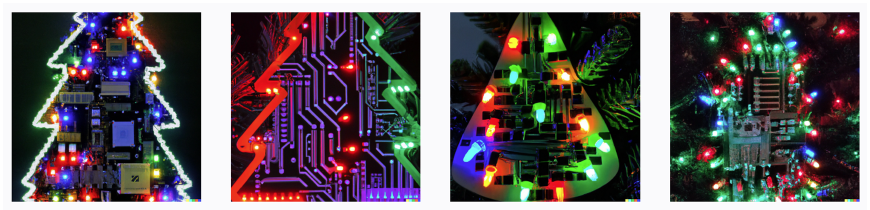
As we enter the holiday season, may I please add “May the AI be with you!” to our customary holiday wishes to you and your family? As a test, I typed in the phrase “colorfully lit Christmas tree with electronics board theme” into the image generation AI named DALL-E (https://labs.openai.com/ ), and it produce the following images, within a minute, and importantly, without any artistic ability or effort on my part:
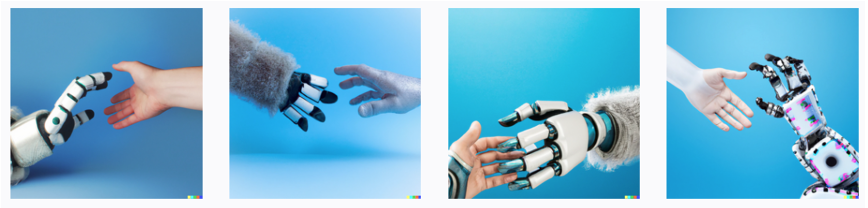
Here is another example generated from the phrase “furry robot hand reaching out to a human hand blue background”
I can imagine using this system to generate illustrations for my presentation slides even though my artistic skills are sorely limited.
Interestingly, DALL-E is a companion system to ChatGPT (https://chat.openai.com/chat ), and it is already common for graphic experimenters to use ChatGPT to create optimal queries to DALL-E that generate remarkably detailed illustrations. I was able to easily generate an image of a white tiger walking on a purple tightrope against a yellow background.
Introduced just a few weeks ago, my colleagues and I became aware of ChatGPT, and started to experiment with it, with ECE uses in mind. ChatGPT is a freely available generative AI tool. Based on my initial experiments, it appears to be an impressive polymath robot that can carry on surprisingly human-like conversations on a wide range of subjects including engineering and mathematics, history, biology, and economics, calculate signal transforms given a plain English sentence question (example below), write code in a variety of programming languages, debug computer programs, summarize books, and formulate differential equations. It is no wonder that it picked nearly a million users in its very first post-debut week, indicative of a potentially disruptive/transformational technology with the potential for major impact. As of this writing, the ChatGPT servers were overloaded.
ChatGPT is based on a Generative Pretrained Transformer neural network that encodes a natural language model trained on an extremely large dataset drawn from the internet. This model was trained on data from circa 2021, and the ChatGPT system does not have a live connection to the world wide web. All of its responses are, therefore, in a sense, frozen in time. Since this network was trained on a dataset that is not guaranteed to be accurate, the ChatGPT system is not guaranteed to produce accurate responses. To be clear, ChatGPT does not yet pass the Turing Test (https://en.wikipedia.org/wiki/Turing_test) but comes uncomfortably close on many conversations.
Despite these limitations, this is a technological advance that has the potential to alter the higher education landscape. Importantly, this is a tool that will surely be refined every year and will become more and more capable. Importantly also, this tool is not alone. For example, Google has a tool named LaMDA (https://blog.google/technology/ai/lamda/) that can be accessed on Android phones using an App named 'AI test Kitchen'.
Bottom Line: In the Spring 2023 semester, expect your faculty who are evaluating their student's work, to wonder if parts of the reports (or entire reports) were generated by an AI tool. We have been at a similar juncture during the pandemic, as we struggled with inauthentic student work using websites like Chegg.com. The threats from these new AI tools exist at an entirely new level.
When Calmer Thoughts Prevail
The field of Artificial Intelligence (AI) has always teased and fascinated us since the seventies. It has occasionally stunned us as AI-based systems publicly beat the reigning human champions of mentally challenging games like Chess and Go. Notwithstanding all the press these advances received, the underlying software systems remained in the background, out of public access.
To be clear, AI tools are not altogether new. On a day-to-day level, most of us have used byproducts of past AI research, for example, Mathematica (https://www.wolfram.com/mathematica/ ) to do the messy math for us, and Grammarly to help our students write better and protect against plagiarism (https://www.grammarly.com ). The more ambitious field of “General AI” has been an aspirational goal for many decades, until perhaps, now. With the advent of ChatGPT and its peer tools, we are probably entering the age of “Broadly Applicable AI”.
The Awful Questions that First Come to Mind
Notwithstanding the known limitations and caveats, progress in broadly applicable AI raises big questions for ECE faculty. The first round of questions is of an apprehensive nature:
- Is this technology a threat to academia?
- Can it inflict harm on our educational mission?
- What kinds of disruptions will it cause?
- Will it make many career options, e.g., software developer, engineer, educator, or graphic artist, obsolete?
- Will students misuse it to write authentic-looking but AI-generated reports, take-home/online exams, theses, and such, making our task of educating students harder?
While better-developed answers to these questions will surely materialize over the next weeks and months, it is fair to assess that this is a disruptive technology, and our students will put AI to use for their assignments. As a concrete example, I presented an undergraduate MATLAB programming problem asking a student to write a program to sum the Basel series to a finite number of terms to ChatGPT, and here is how it went:
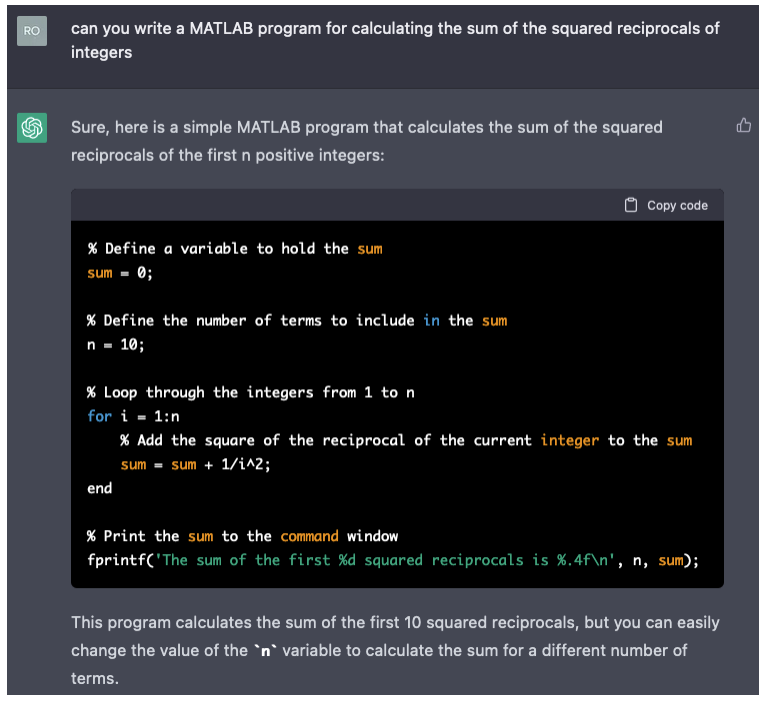
Wow. I was impressed that the AI not only produced correct code but also provided helpful comments as a good student would. Interestingly, this AI can generate code in numerous other programming languages for far more complex tasks, including the creation of new applications (Apps).
Next, I posed a simple question regarding Laplace transforms, and here is a transcript of my conversation with ChatGPT:
Badri: if X(s) is the Laplace transform of x(t), what is the Laplace transform of x(at+b)?
ChatGPT: The Laplace transform of $x(at+b)$ is given by
$$\mathcal{L}{x(at+b)} = \frac{1}{a} X\left(\frac{s}{a}\right).$$
This can be derived by making the substitution $u = at+b$ in the integral defining the Laplace transform, and then defining $v = (u-b)/a$. The resulting integral can then be evaluated using the fact that the Laplace transform of a shifted and scaled version of a function is related to the original Laplace transform of the function.
Badri: Sorry, your answer is incorrect. The answer does not include b
ChatGPT: You are correct, the Laplace transform of $x(at+b)$ should be given by
$$\mathcal{L}{x(at+b)} = e^{-sb/a} \frac{1}{a} X\left(\frac{s}{a}\right).$$
This can be derived using a similar method as before, but with an additional factor of $e^{-sb/a}$ arising from the shift of the function $x(at+b)$ by $b/a$. I apologize for the mistake in my previous response.
Badri: Thank you. You got it right this time
ChatGPT: You're welcome! I'm glad I was able to provide the correct answer this time. If you have any other questions, feel free to ask. I'll do my best to help.
Badri: I am curious as to why your first response was incorrect
ChatGPT: In my first response, I failed to consider the effect of the shift of the function $x(at+b)$ by $b/a$ on its Laplace transform. As a result, the expression I gave for the Laplace transform of $x(at+b)$ was missing the factor of $e^{-sb/a}$. This factor arises from the shift of the function and is necessary for the Laplace transform to be correct.
I apologize for any confusion or inconvenience my mistake may have caused. As a large language model trained by OpenAI, I do my best to provide accurate and helpful information, but I am not perfect and may occasionally make mistakes or provide incomplete answers. If you have any further questions or concerns, please don't hesitate to ask. I'm here to help.
My colleague David Mayerich used ChatGPT to, for example, Calculate spherical Bessel functions in C++ (https://sharegpt.com/c/GoeMu4A), help answer questions related to coupled wave optical simulations (https://sharegpt.com/c/ZjGKFod), and other questions relating to the Doppler effect, Fourier Transforms, etc. In summary, there is clear potential for students to leverage AI tools as they go about their assignments. They do need to perform appropriate sanity checks of the responses generated by the AI tool and use the results with integrity.
The Nicer Questions that Come to Mind
Once our emotions settle down a bit, nicer, and more hopeful, forward-looking questions come to mind, and here are a few:
- Can it be an enabling tool in the hands of students and faculty?
- Can it help enhance ECE education?
- I am sure you have a long list of additional questions.
Perhaps the best way to tackle these questions is to start by thinking about what makes engineering graduates so valuable. Sure, they know a lot of things, but most of these subjects and topics can be looked up. Interestingly, they can be looked up a lot more efficiently using a tool like ChatGPT compared to a standard Google search or a database search.
Just for fun, I posed the query "How can ChatGPT be used to enhance Engineering Education?" to the AI, and here was its response:
“ChatGPT is a variant of the GPT (Generative Pre-training Transformer) language model that has been modified to support chitchat and casual conversation. It has the ability to generate human-like text based on a given prompt or context, and can be used in a variety of applications, including education.
One potential use of ChatGPT in engineering education is to create realistic and engaging conversation simulations for students to practice communication skills. For example, students could use ChatGPT to practice explaining technical concepts to non-technical audiences, or to practice collaborating with team members on a project.
Another potential use of ChatGPT in engineering education is to generate personalized feedback and coaching for students based on their responses to prompts or tasks. This could help students improve their communication skills and better understand complex concepts.
Overall, ChatGPT has the potential to be a useful tool for enhancing engineering education by providing a platform for students to practice and improve their communication skills in a realistic and engaging way.”
Honestly, communication skills is an area in sore need of improvement for engineering graduates.
At a big picture level, engineering graduates are valued not so much for their factual knowledge but for their problem-solving and scienc-based design skills. Problem-solving requires a diverse collection of synergistic skills including the ability to comprehensively understand the problem at hand in a scientifically sound and quantitative manner, the outputs, inputs, parameters, and all of the associated specifications/constraints in context, and the ability to break down big problems into manageable modules that can be tackled individually, the interfaces between the modules that must be interconnected, data collection and cleanup, proof-of-concept prototyping, project execution, debugging, evaluation, characterization, and refinement in response to field conditions.
When we look at AI tools from the standpoint of a problem-solving engineer, it is easy to realize that the AI tools are, despite all their awesome sophistication, no different from other tools in the engineering toolkit. It is fair to speculate that AI tools will make engineering work more efficient, and more refined. For example, the engineer can save time by replacing time-consuming searches on Google with ChatGPT queries that return far more concise responses. It can be used to remind the engineer of various concepts and facts, provide explanations, and generate code for specific tasks. It can even entertain the engineer with poems and limericks. With such help, engineers will be able to scale up projects better, and we will be able to measure the effectiveness of engineered systems in a more meaningful manner. Finally, as suggested by the AI itself, ChatGPT can assist engineers in the following ways:
“Engineers can use ChatGPT in a variety of ways to improve their communication skills, generate ideas, and collaborate with others. Here are a few potential uses for ChatGPT in engineering:
- Collaboration: Engineers can use ChatGPT to collaborate with team members on a project, brainstorm ideas, and generate solutions to problems.
- Explanation: Engineers can use ChatGPT to practice explaining complex technical concepts to non-technical audiences, such as clients or stakeholders. This can help them improve their communication skills and better convey the value of their work.
- Documentation: Engineers can use ChatGPT to generate technical documentation or reports, saving time and effort while still producing high-quality content.
- Training: Engineers can use ChatGPT to create personalized training materials or simulations for themselves or others, helping to improve skills and knowledge in a specific area.
Overall, ChatGPT can be a valuable tool for engineers looking to improve their communication skills, generate ideas, and collaborate with others in their field.”
Overall, I tend to lean toward the hopeful side. I hope that you concur. Importantly, we invite you to share your ideas on how to deal with these newfangled AI tools as we rededicate ourselves to our educational mission in the new year.