
October 2026
New Department Chair Feature
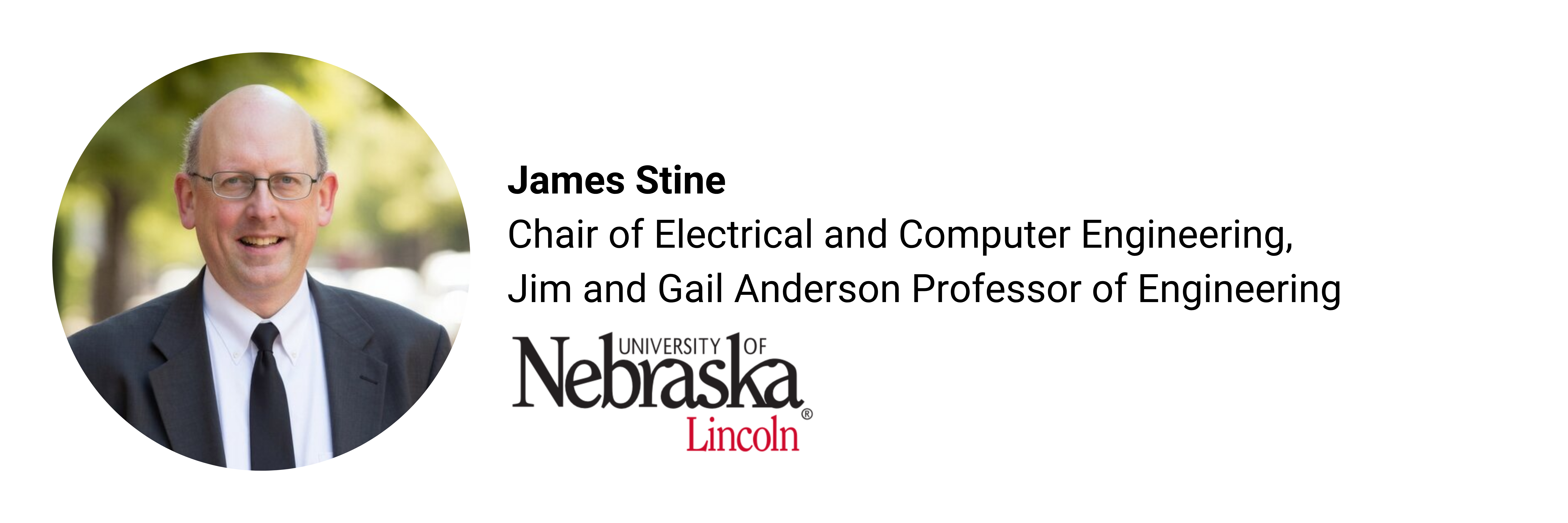
Q. Tell us abbout yourself and your background
I recently joined the University of Nebraska–Lincoln as Chair of the Department of Electrical and Computer Engineering and as the Jim and Gail Anderson Professor of Engineering. Before coming to Nebraska, I spent more than two decades at Oklahoma State University, where I was a professor of electrical and computer engineering and held the Edward Joullian Endowed Chair in Engineering.
My academic background is in computer engineering, with research interests spanning computer architecture, VLSI and ASIC design, computer arithmetic, low-power digital systems, and open-source semiconductor design. Much of my work has focused on making integrated-circuit design more accessible to students and researchers. My group has contributed to open-source standard-cell libraries, memory compilers, design-automation tools, and RISC-V processor platforms.
Throughout my career, the most rewarding part of my work has been mentoring students and seeing them move from learning fundamental concepts to designing systems with real-world impact. I have also valued opportunities to connect university research with industry and national needs, particularly in semiconductor technology, aerospace, and defense.
Q. What inspired you to take on the role of department chair?
I was attracted to the opportunity to help create an environment in which faculty, staff, and students can do their best work. A chair can help bring people together, remove barriers, develop resources, and connect individual strengths to a larger departmental vision.
Nebraska was especially compelling because of the breadth of the department, its presence in both Lincoln and Omaha, and the opportunity to build stronger partnerships across the University of Nebraska system. Electrical and computer engineering touches nearly every major technological challenge—from AI, semiconductors, and quantum systems to health care, energy, communications, and national security. I saw an opportunity to help an already strong department become even more connected, collaborative, and visible.
Q. Since stepping into this role, what has been the most surprising or unexpected aspect of the position?
The breadth and pace of the position have been striking. In a single day, a chair may discuss a student concern, a faculty research opportunity, laboratory equipment, curriculum, hiring, an industry partnership, and the long-term direction of the department.
I have also gained an even greater appreciation for how much important work happens behind the scenes. Many seemingly small decisions can have a meaningful effect on students, faculty, and staff. The role requires balancing immediate needs with long-term goals while remembering that departments are ultimately built around people and relationships.
Q. What are your immediate prioriites and goals for your department?
My first priority is to listen and learn—to understand the aspirations of our faculty, staff, students, alumni, and partners and to identify where departmental leadership can help them succeed.
I would like to strengthen the connections between our programs in Lincoln and Omaha while preserving the distinctive strengths of each location. Other priorities include recruiting and retaining excellent faculty and students, expanding research support, modernizing our educational laboratories, and creating more hands-on opportunities in areas such as quantum, digital systems, embedded computing, semiconductors, AI, communications, energy/power, and cyber-physical systems.
I also want to deepen our relationships with industry, government agencies, other universities, and partners throughout the University of Nebraska system. I strongly believe that some of the most important innovations of the future will emerge where engineering intersects with fields such as medicine, agriculture, national security, and the physical sciences. Our department should be an active and welcoming partner in creating those connections.
Q. In your view, what is the most essential quality for a department chair to possess - and how do you cultivate that in your work?
I believe the most essential quality is the ability to listen with humility. A chair will never have all the answers, and the people closest to a challenge often have insights that leadership needs to hear.
Listening builds trust, but it must be followed by thoughtful and transparent action. I try to cultivate that by being accessible, asking questions, seeking perspectives from people with different experiences, and explaining the reasoning behind decisions. Leadership is not about advancing one person’s agenda; it is about helping a community establish shared priorities and make progress together.
Q. What are you most looking forward to as a member of the ECEDHA community?
I am looking forward to learning from colleagues who understand both the opportunities and challenges of leading electrical and computer engineering departments. ECEDHA provides a valuable forum for sharing effective practices, discussing emerging technologies, and considering how our programs must evolve to prepare the next generation of engineers.
I am particularly interested in conversations about semiconductor education, research infrastructure, industry partnerships, workforce development, faculty mentoring, and the rapidly changing role of AI in engineering. I also look forward to identifying opportunities for collaboration among departments and contributing to a collective voice for electrical and computer engineering education.
Q. Tell us a fun or interesting fact about yourself!
Nearly six years ago, I became involved in an open-source integrated-circuit initiative launched by Google to help strengthen and broaden the silicon ecosystem. Google partnered with SkyWater Technology to release the SKY130 Process Design Kit, making manufacturing rules, device models, and related design resources—information traditionally kept proprietary—openly available.
My contribution involved developing and deploying open-source standard-cell libraries. These libraries contain the fundamental building blocks of digital chips, including logic gates, registers, and other carefully characterized circuit elements. By connecting these libraries with open-source design tools and a manufacturable process, we helped enable students, researchers, startups, and smaller organizations to participate in integrated-circuit design without many of the traditional cost and licensing barriers.
It has been tremendously rewarding to see open-source silicon grow from an ambitious experiment into an international ecosystem for education, research, innovation, and actual chip fabrication. I also feel a deep obligation to help students discover the same spark that I experienced nearly half a century ago when I first began working with computers. That early sense of curiosity and possibility shaped the course of my life. If I can help make these technologies accessible enough for a student to experience that same moment—to realize that they can understand, design, and improve the systems around them—then I am helping repay a debt to the teachers, mentors, and opportunities that made my own career possible.